
Commentary by Keenan Yoho, Banor Senior Advisor
The Return of Sovereignty and the New Operating Logic
The House of Atreus
There once was an ancient Greek royal family, the House of Atreus, who lived under a divine curse with each generation answering the killings of the one before. A king sacrificed his daughter for a favorable wind to war, his wife killed him on his return, their son killed his mother to avenge his father, and the Furies rose from the earth to hunt down the son. Though different in kind, the quarrel between the United States and Iran is one of a similar logic and that of mutual retaliation. Iran’s institutional memory runs from the U.S. and British Operation Ajax which was the 1953 coup against Prime Minister Mohammad Mossadegh through the killing of Quds Force commander Major General Soleimani in 2020 to the 12-day war of July 2025. America’s open wounds began with the 1979 hostage seizure through the killing of more than 200 U.S. Marines in Beirut and decades of proxy war and Iran’s unfinished nuclear weapon.
The U.S. and Israeli war with Iran that began February 28, 2026, with shock, awe, and the killing of Iran’s Supreme Leader has now slowed to an economic siege. The siege is playing out in two ways: the U.S. is laying economic siege to Iran through a blockade of its ports and Iran is laying economic siege to any and all nations dependent on products that must transit the Strait of Hormuz. The two-week cease-fire that was negotiated April 7, 2026, was extended indefinitely by President Trump yet military clashes at sea continue to take place.
The Rubicon cannot be un-crossed
U.S. military power in the region culminated on or about April 15, 2026. However, there has been no expurgation of the offense of 1979 or final blow. President Trump possessed the audacity to attack but has lacked the resolute conviction to follow through. The “TACO,” or “Trump always chickens out,” moniker has stuck. But any belief President Trump may have that the surviving Iranian regime will indulge his patrimonialism in exchange for a concession is deeply flawed. In President Trump’s world, there are rational actors who may use guile, deceit, trickery, and flattery but they are rational nonetheless and everyone has a price. For the ideologues in the Iranian regime there is no price: there is a cause. And a cause is not a position that is traded. A cause is an identity that is defended and a wound that must be avenged. So, transactional negotiators like President Trump quickly discover that what they offer is not acceptable because they are working in the wrong currency and the ideologues keep a ledger of a different kind. When Trump struck down Iran’s Supreme Leader, and simultaneously mutilated his son, he failed to internalize what he was actually doing. He had not decapitated the regime but instead had enthroned a surviving martyr. The only path to peace in the new world that has been unleashed is the destruction of the original object which is, and has been since 1979, the Iranian regime.
The weaker power wins the long game
One truth in war is that the weaker power wins the long game. The weaker power is almost always defending its existence rather than a narrow set of interests. However, the weaker side wins only if it survives long enough to play the game. Because President Trump has established military superiority but not military dominance in the region he has gifted the Iranian regime a weapon the U.S. never intended to give. In the course of just 60 days, President Trump managed to kill Iran’s Supreme Leader and cripple its economy which was something that has been all but impossible politically and militarily for more than 40 years. But while doing so he simultaneously gave his enemy a structural rent on global commerce through a toll gate that did not exist before. Iran’s leverage is now grounded in geography and the duration of possession is being dictated by a negotiation engineered to never conclude and that is not about whether the toll exists but about who pays it and how much. This reversal of fortune was achieved through a profound lack of military conviction and unmistakably perceived as weakness by the Iranian regime.
Still, Iran’s current economic position is grim and three key indicators signal that its ability to hold out for a long, long, game may be in doubt. First, the Iranian rial has lost nearly 97% of its dollar value since January 2026. This development has forced the regime to issue a 10-million-rial banknote worth $7 U.S. dollars and resulted in daily bank withdrawal caps of the equivalent of $18 to $30 U.S. dollars which will purchase 3 to 5 kilograms of red meat or 6 to 10 kilograms of rice today. Consumer prices are predicted by the International Monetary Fund (IMF) to have risen almost 70% (see chart for real GDP and inflation figures) and food inflation continues to rise and is currently forecast to be at approximately 105%. Finally, the overall Iranian economy is rapidly contracting and the IMF predicts a reduction in gross domestic product (GDP) to be -6% or more in 2026.
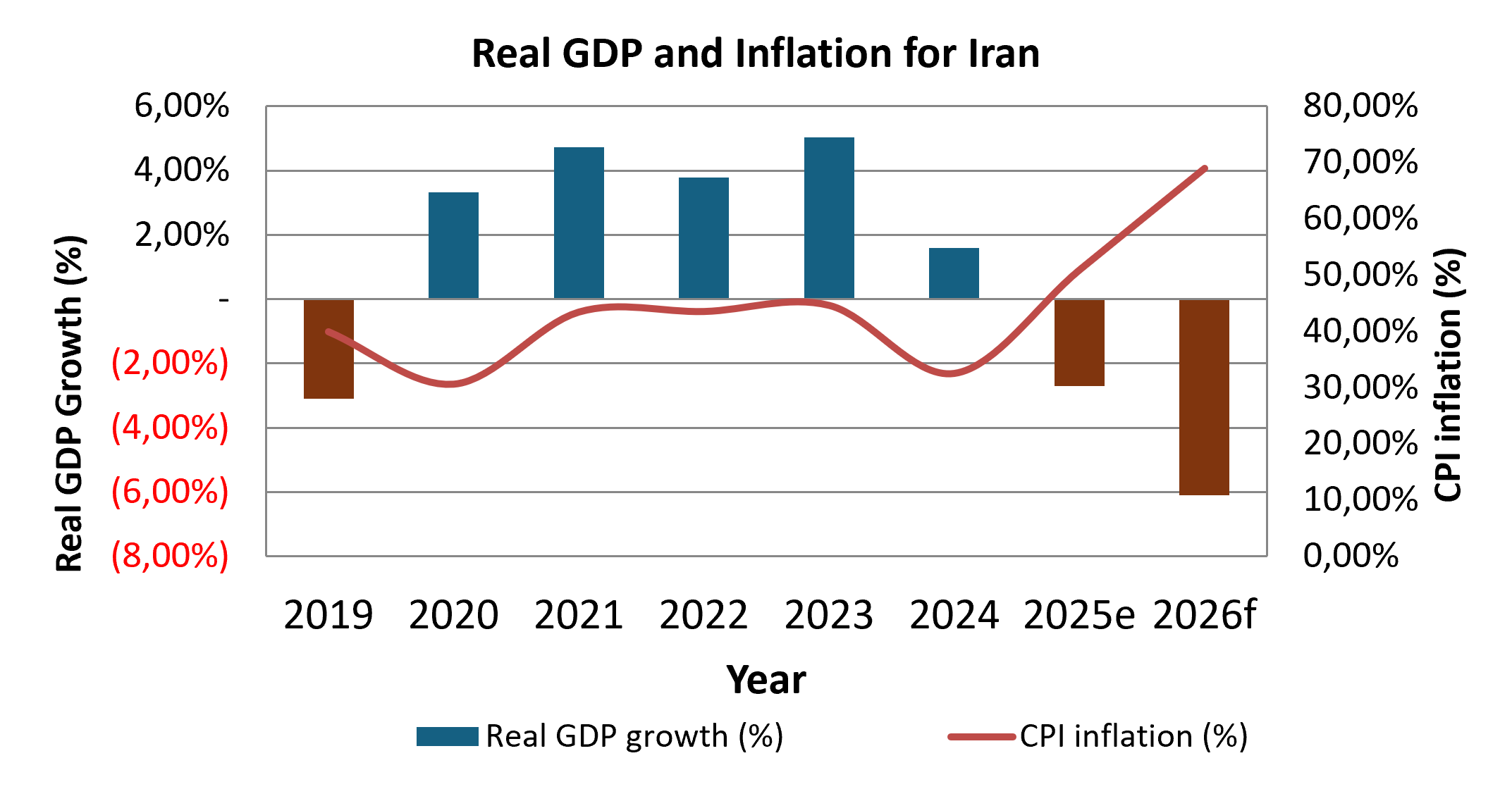
Sources:International Monetary Fund and World Bank
The weaker power does not have to defeat the stronger one but only outlast its patience. But the Islamic Republic was built on the wager that its population would tolerate austerity longer than America could stomach the cost of confrontation. What has changed is that Iranians are now measuring time in the price of bread which is a clock the regime never planned to race.
The logic of this conflict does not abide half-measures and no party may be left half-alive as it only guarantees the next round. The current dynamic can easily play out for months or years. Only the destruction of one party or the other will close the account. The threat of annihilation was the only leverage the U.S. had over Iran in the face of a threat to the Strait of Hormuz. With the killing of its Supreme Leader, the U.S. has diminished its leverage. President Trump now dwells in the House of Atreus.
The information and opinions contained herein do not constitute an invitation to take out a contract for the provision of investment services, nor a personalised recommendation; they are not contractual in nature, they are not drafted pursuant to a legislative provision, and they are not sufficient to make an investment decision. The information and data are deemed to be correct, complete and accurate. However, Banor does not issue any representation or guarantee, express or implied, on the accuracy, completeness or correctness of the data and information and, where these have been prepared by or derive from third parties, does not assume any liability for the accuracy, completeness or adequacy of such data and information, even if its sources are deemed to be reliable.
Unless indicated otherwise, the data, information and opinions are understood to be up-to-date at the date of preparation, and may change without notice or subsequent communication. Any citations, summaries or reproductions of the information, data and opinions provided herein by Banor should not alter their original meaning, nor may they be used for commercial purposes, and they must cite the source (Banor SIM S.p.A.) and the website www.banor.it. Citation, reproduction and use in any case of data and information from third-party sources must, if permitted, fully comply with the rights of the related data controllers.
Banor SIM S.p.A., via Dante 15 – 20123 Milan, registered in the Business Register of Milan 06130120154 – R.E.A. (Economic and Administrative Index) of Milan 1073114. Consob authorisation, resolution no. 11761 of 22/12/1998. Registered in the Register of Brokerage Companies (SIM) under no. 31 and member of the Italian National Guarantee Fund (Fondo Nazionale di Garanzia).