


Commentaries by Banor portfolio managers
MARKET OUTLOOK – 2026: SECOND HALF INSIGHTS

The second half of 2026 begins in an environment that still appears favourable for growth, but with increasing signs of imbalance between solid fundamentals, elevated valuations, and the absorption of liquidity.
The U.S. economy continues to benefit from strong corporate earnings growth and financial conditions that, at least for now, remain compatible with the continuation of the equity market rally. Nominal and real interest rates are still at historically normal levels and do not currently represent a decisive obstacle for risk assets. However, the picture is becoming more complex.
The massive investment cycle linked to artificial intelligence, the revival of the IPO market, increased defence spending, the rising cost of public debt, and the rebuilding of strategic oil reserves are all contributing to a gradual absorption of global liquidity.
The key question for the second half of the year will therefore be whether earnings growth will be sufficient to offset very high valuations and a potentially rising cost of capital.
Monetary policy is once again becoming a crucial factor in the sustainability of the rally. The new Federal Reserve Chair, Kevin Warsh, began his tenure with a very clear message: keep inflation under control and bring it sustainably back toward the 2% target. In this context, if inflationary pressures remain persistent, the Fed could be forced to raise interest rates once or twice during the second half of 2026. This would represent a significant shift from current market expectations.
So far, the equity rally has been supported by the belief that both real and nominal interest rates would remain at manageable levels. However, any further increase in rates would raise the cost of capital and put pressure particularly on more heavily indebted companies, less profitable business models, and the market segments most sensitive to interest rates.
The risk is not limited to monetary policy alone.
In the second half of 2026, several factors could contribute to a significant absorption of liquidity:
- the resurgence of the IPO market, with large-scale offerings following SpaceX and potential new listings from companies such as Anthropic, OpenAI, and other artificial intelligence-related players;
- increased global investment in defence;
- the growing cost of government debt in an increasingly indebted world;
- the replenishment of strategic oil reserves following the end of the U.S.-Iran war;
- the costs associated with reconstruction efforts in the Middle East.
The combination of these factors could lead to a structural increase in the cost of capital, with significant implications for investment selection. In particular, companies with high financial leverage and high-yield corporate bonds appear more vulnerable in an environment characterised by higher interest rates, reduced liquidity, and greater investor selectivity.
Such a scenario would likely favour businesses with strong balance sheets, sustainable cash flows, and a proven ability to generate profits, while placing pressure on issuers that rely heavily on external financing or have weaker credit profiles.

Valuations in the U.S. equity market are currently at extremely high levels. Broad indicators such as the Warren Buffett Ratio—the ratio of total stock market capitalisation to GDP—and the ratio of market capitalisation to monetary aggregates such as M2 suggest levels that are close to, or above, historical highs. This indicates that the market is already pricing in very ambitious expectations for future earnings growth and for companies’ ability to monetise new technological trends.
The primary support for the market remains earnings growth, which continues to be very strong. As long as corporate earnings keep surprising to the upside and interest rates remain at levels considered normal, the rally can retain a solid fundamental basis. However, the quality of the advance appears less robust than headline indices suggest.
Market performance has in fact been driven by a relatively narrow group of sectors and themes. The semiconductor sector has delivered exceptional gains, with its benchmark index rising by approximately 100% year-to-date. Companies directly or indirectly linked to the boom in artificial intelligence infrastructure investment—including DRAM manufacturers, neo-cloud providers, hardware suppliers, data centres, and other beneficiaries of AI-related capital expenditures—have recorded very strong performance.
The scale of the AI investment cycle is unprecedented. The current capital expenditure boom is estimated to be roughly seven times larger than that seen in the Technology, Media, and Telecommunications (TMT) sector during the 1999–2000 period. In 2026 alone, AI-related investments could reach approximately $800 billion.
This is an enormous figure that underscores the industrial significance of the transformation currently underway. At the same time, it raises important questions about the long-term financial sustainability of the investment cycle.
These record levels of capital expenditure could absorb much, if not all, of the cash generated by the Magnificent Seven. As a result, the major U.S. technology companies may have less capacity to support the market through share buybacks, which in recent years have been an important source of support for U.S. equity indices.
The risk is that the market is pricing in not only very strong AI-driven growth, but also a flawless ability to translate these investments into high and rapid economic returns. Should the current FOMO (Fear of Missing Out) surrounding artificial intelligence-related stocks begin to fade, the most richly valued segments of the market could be exposed to significant corrections.
Another sign of strong risk appetite is the ratio between cyclical and defensive stocks, which has risen to historical highs. This suggests that investors are pricing in a highly favourable outlook for economic growth and corporate earnings while penalising more defensive sectors. Historically, such extreme levels have often been associated with late-stage market environments characterised by elevated optimism and a shrinking margin of safety.
Consequently, if AI momentum were to slow, the cost of capital were to rise, or earnings were to disappoint, a sharp rotation from cyclical stocks into defensive sectors could occur.
At the same time, the significantly lower valuations currently seen in European and Chinese equity markets could encourage a geographic rotation away from the U.S. stock market toward regions that have lagged behind and remain comparatively cheaper.
Focus on the European Market
The second half of the year looks set to be an interesting period for the European equity market, although the crystal ball remains firmly out of service.
Inflation remains a somewhat unwelcome guest, but it appears less noisy than in recent months. Corporate earnings will be the real test in determining which companies genuinely have their finances in order. In Europe, earnings upgrades have been less aggressive than in the United States, but they have been more broadly distributed across sectors. The industrial, technology, and financial sectors could offer attractive opportunities, albeit selectively and provided investors resist becoming overly attached to individual stocks and carefully consider what is already reflected in current valuations. Geopolitics will also continue to remind us that financial markets do not operate in a vacuum. For patient investors, however, periods of volatility can often be transformed into attractive opportunities. The key watchword remains diversification: fewer fireworks and more balance within portfolios. Prudence and optimism can coexist, as long as no one expects the market to follow a predetermined script and remains prepared for unexpected shifts in the investment landscape.
Focus on the Italian Market
The Italian market has been one of the best performers since the beginning of the year, but much of the credit goes to its sector composition. The rally has been concentrated primarily in the financial sector (supported by ongoing banking consolidation) and in companies linked to data centres and semiconductors (such as STMicroelectronics and Prysmian). In contrast, sectors that are more central to the Italian economy—namely industrials and small and mid-sized enterprises (SMEs)—have remained flat or delivered negative performance.
For the fourth consecutive year, the FTSE MIB has significantly outperformed the STAR Index. As in many markets around the world, Italy has experienced the same broad trend: investment flows have been directed toward large-cap companies and a limited number of dominant investment themes, resulting in increasingly concentrated returns.
Looking ahead to the second half of the year, we believe it may be more challenging for these trends to continue. The key word is “broadening.” In other words, the market could shift toward a more meaningful recovery among stocks that have lagged behind, rather than further gains being concentrated in the existing winners. Such a broadening of market participation would create opportunities in areas that have so far been overlooked by investors, potentially allowing industrial companies and smaller-cap stocks to narrow the performance gap with the market leaders.
This would also contribute to a healthier and more balanced market environment, reducing dependence on a handful of sectors and companies.
Focus on the Chinese Market
The Chinese equity market currently represents only about 4% of the MSCI All Country World Index, a relatively small weighting compared with the size of the country’s economy, which accounts for approximately 18% of global GDP, and the increasingly sophisticated quality of its industrial base.
China is home to a growing number of highly competitive companies, some of which are already global leaders in their respective industries, yet they trade at valuations that are more than 50% lower than those of comparable U.S. companies.
The most attractive opportunities can be found in sectors where China has built a structural competitive advantage, including electric vehicles, solar panels, automotive components, robotics, and artificial intelligence.
In a scenario where investors rotate capital away from the United States, this valuation discount could become a significant performance catalyst for Chinese equities.
What Risks Should Investors Be Watching?
- The first risk concerns valuations. With the U.S. market at record levels relative to GDP and M2, its ability to absorb negative shocks is more limited. In the absence of equally exceptional earnings growth, valuation multiples could become difficult to justify.
- The second risk is the concentration of the rally. The strong performance of semiconductors and stocks linked to AI-related capital expenditure has been a key driver of the rise in market indices. This makes the market more vulnerable to profit-taking or a scaling back of expectations for these sectors.
- The third risk concerns the sustainability of AI capex. Investments amounting to roughly seven times those of the 1999–2000 TMT cycle, and reaching approximately $800 billion in 2026 alone, represent an enormous bet on future demand. If economic returns do not materialise quickly, the market could begin to question the profitability of this investment cycle.
- The fourth risk is related to liquidity. The revival of the IPO market, increased defence spending, the higher cost of government debt, the replenishment of strategic oil reserves, and reconstruction costs in the Middle East could absorb significant amounts of liquidity. This would make the environment less supportive for risk assets and more selective for credit markets.
- The fifth risk concerns the cost of capital. A Federal Reserve that is more determined to bring inflation back toward 2%, even through one or two rate hikes in the second half of 2026, could weigh on the most rate-sensitive segments of the market and on highly leveraged companies. In this context, it will be important to pay close attention to high-yield corporate bonds, which could suffer both from higher required yields and from a deterioration in credit quality.
- Finally, the extremely strong positioning in favour of cyclical stocks relative to defensive ones suggests that the market is pricing in an almost perfect scenario. Any sign of a macroeconomic slowdown, margin deterioration, or downward earnings revisions could lead to a significant rotation toward more defensive sectors.
The Dramatic Reversal in the Interest Rate Outlook

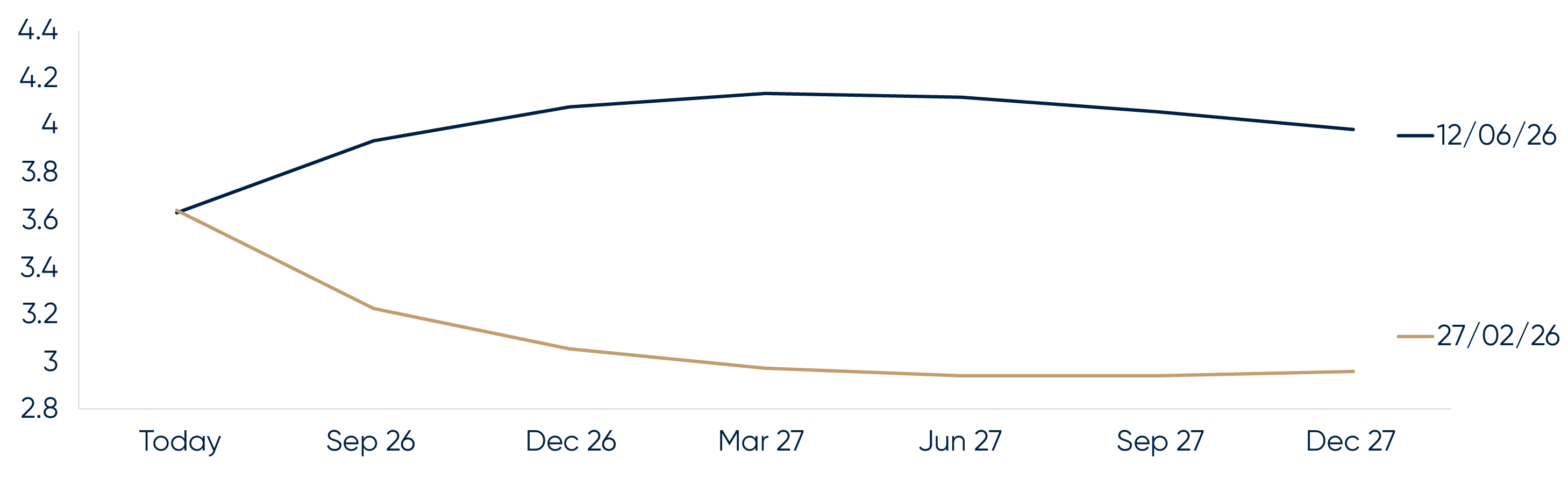
At the beginning of the year, the dominant narrative was still that artificial intelligence would usher in an era of abundance, productivity gains, and disinflation. In that world, the Federal Reserve could comfortably continue cutting interest rates. Indeed, between late 2025 and early 2026, the market was still pricing in roughly two rate cuts during the year.
Today, that dream has fallen apart: the market is no longer pricing in any rate cuts. On the contrary, there is now open discussion about the possibility that the next move could be upward rather than downward.
Fed expectations
Source: Bloomberg, Banor
The most obvious explanation is the war with Iran and the rise in oil prices. In this context, Kevin Warsh, appointed by President Trump to lead the Fed with the explicit expectation that he would steer it toward lower rates, finds himself in an awkward position: he may have to explain to the President that there is no room to lower rates.
But it would be a mistake to blame only oil prices and the military campaign in Iran.
Once the initial inflation shock was absorbed, expectations for U.S. interest rates did not merely become less dovish—they shifted toward the risk of further rate hikes. This is where a deeper phenomenon comes into play: the rise in real interest rates.
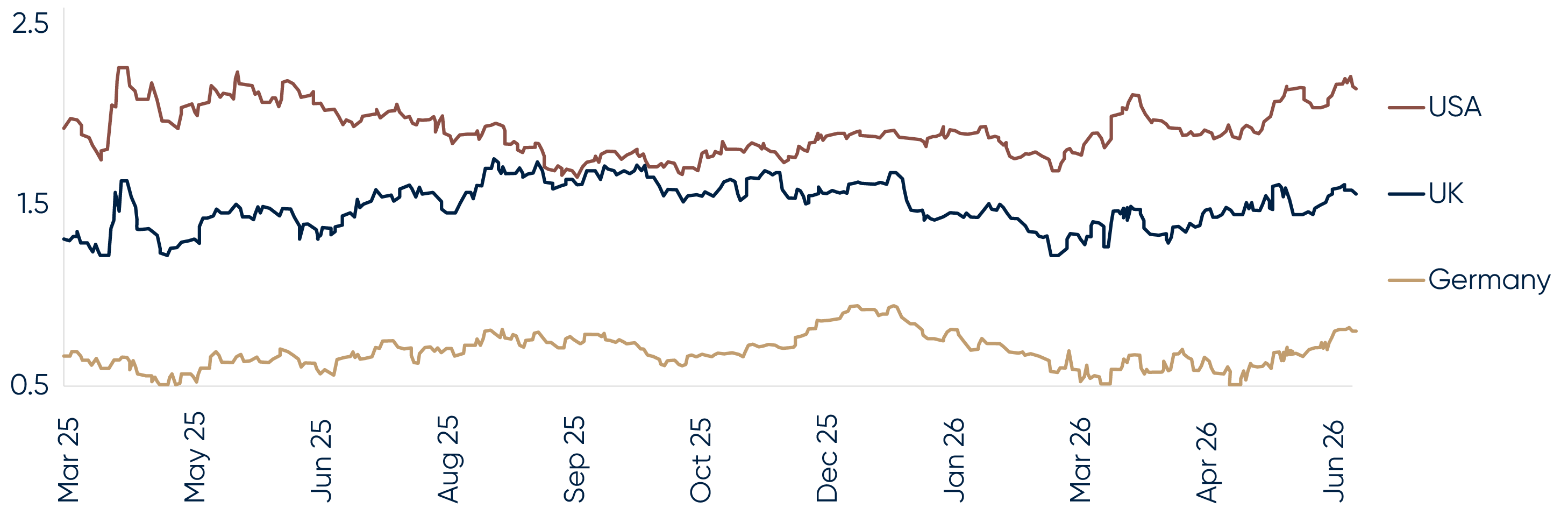
Real Interest Rates
U.S. 10-year real Treasury yields have moved sharply higher, followed by real rates across the rest of the developed world.
Source: Bloomberg, Banor
This is not merely a technical detail. It signals that the market now believes the equilibrium real interest rate is higher than it thought just a few months ago. That typically happens when growth is stronger than expected, the labour market remains resilient, and demand for capital stays high. While the data do not point to a boom, they clearly point in that direction.
The U.S. economy is increasingly characterised by stark contrasts—what Americans often call a “K-shaped economy.” Wealthier consumers continue to spend, while the middle class struggles.
Research from the New York Fed shows that recent consumption growth has been driven primarily by households earning more than $125,000 per year. Growth is therefore becoming increasingly unbalanced, less inclusive, and socially problematic. Yet from the perspective of aggregate GDP, it remains a success. It may not be pleasant to observe, but it is robust enough to prevent real interest rates from declining.
AI Infrastructure
What matters most for bond markets is that growth is being driven not only by affluent consumers but also by an investment cycle that is reaching increasingly significant dimensions.
At the centre of this cycle is AI infrastructure: data centres, chips, fibre networks, power generation, cooling systems, transformers, land, and electrical grids. This is not about lightweight software—it is about physical infrastructure. S&P Global estimates that investment in data centres and high-tech activities added roughly half a percentage point to U.S. GDP in the second quarter of 2025 relative to a normal spending environment. For this reason, it is not an exaggeration to say that without data centres, the U.S. economy would be considerably cooler. That is a fair approximation of the direction in which the economic cycle is moving.
And this is precisely where the macroeconomic significance of what is happening becomes evident:
- Goldman Sachs estimates $765 billion in AI-related capex in 2026, rising toward $1.6 trillion annually by 2031.
- McKinsey projects nearly $6.7 trillion in cumulative data-centre investment by 2030.
- Morgan Stanley estimates approximately $2.9 trillion in data-centre construction spending through 2028.
These figures should be interpreted carefully. Not all of this spending will be financed through investment-grade bonds, and not all of it will pass through public markets.
Nevertheless, the message is clear: this is not merely a stock-market fad but one of the largest infrastructure investment cycles of our era. For years, large U.S. technology companies were able to self-finance their growth. The technology sector was made up of only occasional debt issuers. Today, however, debt has become one of the primary channels for financing this build-out. In 2025, five hyperscalers—Amazon, Alphabet, Meta, Microsoft, and Oracle—issued $121 billion of corporate bonds, compared with an annual average of $28 billion during the previous five years. UBS estimates that U.S. investment-grade technology bond issuance could reach $360 billion in 2026, roughly one-fifth of the entire investment-grade market.
This is no longer an idiosyncratic phenomenon. It is a market phenomenon—and increasingly a macroeconomic one as well.
Credit Spreads
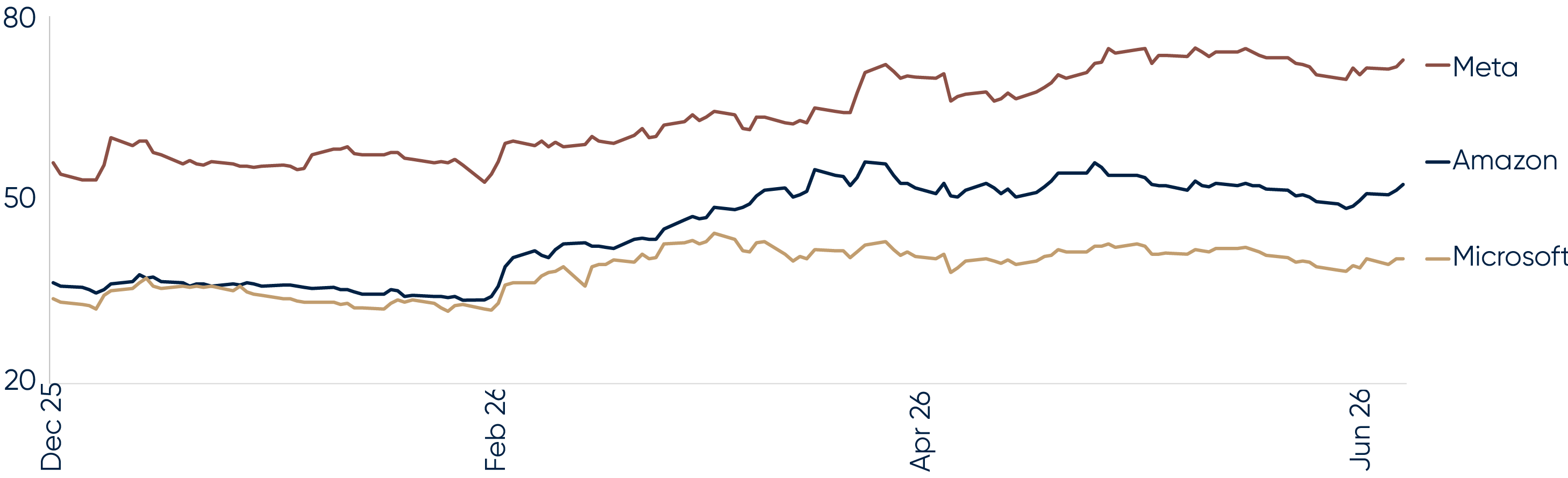
This also helps explain what is happening to credit spreads. The U.S. corporate bond market, taken as a whole, is not in crisis. Average investment-grade spreads remain around 75 basis points. However, beneath the surface, something has changed.
CDS spreads of the three hyperscalers
Source: Bloomberg, Banor
The market is not suggesting that hyperscalers are at risk of default. Rather, it is signalling something subtler—and, for bond investors, very important: Capital is no longer free, even for the champions of the AI era, and future financing needs must now be priced in.
This is why the comparison with the late 1990s is becoming increasingly relevant. Back then it was telecommunications companies; today it is the hyperscalers. Back then investors financed fibre-optic networks and 3G infrastructure; today they finance Nvidia chips, data centres, and electrical capacity. In both cases, dominant companies that had long been regarded as nearly untouchable began investing as though even their exceptional cash generation was no longer sufficient. The Richmond Fed and the OECD describe the telecommunications boom—and subsequent bust—as an extraordinary investment cycle supported by enormous expectations and abundant access to capital markets. The key is recognising the logic of the cycle:
When a sector becomes the major marginal absorber of capital, spreads stop reflecting only balance-sheet quality and begin reflecting financing needs as well.
Conclusions
If this interpretation is correct, then the implication for credit investors is fairly clear. In the near future, it may be prudent to be cautious toward industrial issuers that are most exposed to the new wave of capital expenditure. By contrast, bank bonds today start from a stronger position than they have for much of the past fifteen years. Capital levels have improved, and the balance between supply and demand appears substantially more favourable. Net issuance from the banking sector is expected to remain close to zero—or even contract slightly—making bank bonds relatively attractive due to both their scarcity and their stronger fundamentals.
“Buy European”

For thirty years, Europe benefited from the so-called “peace dividend.” Following the end of the Cold War, much of the continent gradually reduced the priority assigned to military spending, maintaining smaller armed forces, limited stockpiles, and fragmented procurement systems. European security relied, more or less explicitly, on NATO and on the military capabilities of the United States.
This balance began to crack in 2014 with the annexation of Crimea and was fundamentally called into question in 2022 with Russia’s invasion of Ukraine. Since then, defence has returned to the centre of Europe’s political agenda. This is no longer simply a matter of responding to a geopolitical crisis, but of correcting decades of underinvestment and rebuilding an industrial base capable of supporting a more unstable security environment.
The figures clearly illustrate this regime shift. In 2024, defence spending by the 27 EU member states reached approximately €343 billion, equivalent to 1.9% of GDP, an increase of 19% compared with the previous year. Estimates for 2025 point to a further increase to around €381 billion, or about 2.1% of GDP, bringing Europe close to NATO’s 2% spending threshold. The most important point, however, is not only how much is being spent, but how it is being spent. In 2024, defence investment exceeded €100 billion, while equipment procurement reached approximately €88 billion, up 39%. This suggests that governments are not merely funding existing structures, but are attempting to rebuild operational capabilities, stockpiles, industrial production, and critical technologies.
The gap with the United States remains significant. The U.S. Department of Defense budget for 2026 is approaching $1 trillion, highlighting an industrial scale that Europe cannot rapidly replicate. The difference is not merely financial; it also concerns standardisation, multi-year programs, centralised procurement, supply chains, and technological depth. It is precisely this gap that has accelerated Europe’s strategic reassessment. In a more unstable world, relying almost entirely on American military and industrial capabilities is no longer regarded as sustainable.
Accordingly, 2026 is expected to confirm a trend that is now unmistakable. European rearmament is no longer merely an emergency response to the war in Ukraine, but the beginning of a multi-year industrial cycle. The real challenge will not be announcing new budgets, but converting those budgets into tangible capabilities. Defence does not operate like a consumer sector, where supply can be increased quickly when demand rises. Producing ammunition, missiles, radar systems, armoured vehicles, or air-defence systems requires licensed facilities, highly skilled personnel, certified components, secure supply chains, and lengthy qualification processes. After decades of underinvestment, many of these capabilities cannot be rebuilt within a few quarters.
European fragmentation makes the picture even more complicated. The continent operates more than 170 different weapons systems, compared with roughly 30 in the United States. This translates into higher costs, reduced interoperability, more complex logistics, and a diminished ability to produce at scale. Historically, each country tended to protect its own national champion: Germany with Rheinmetall, Italy with Leonardo, France with Thales and Nexter, and Sweden with Saab. While this approach preserved local expertise, it also prevented the emergence of genuine continental-scale defence industries.
For this reason, the new European cycle will be driven by coordination and strategic autonomy. Initiatives such as Readiness 2030, SAFE, the European Defence Fund, and the European Defence Industrial Strategy are all aimed at the same objective: increasing defence expenditure while ensuring that a growing share of that spending remains within European industry.
SAFE, in particular, is designed to finance joint procurement in priority areas such as ammunition, missiles, artillery, drones, cybersecurity, air defence, and military mobility. The political message is clear: “Buy European” is no longer just a slogan—it is becoming an integral part of industrial policy.
Within this cycle, not all areas will grow at the same pace. Some segments are already benefiting from urgent demand, others depend on multi-decade procurement programs, while still others are likely to be transformed by technological innovation.
The first theme is ammunition. The war in Ukraine has reminded Europe of a lesson that many Western militaries had almost forgotten: in high-intensity conflicts, quantity still matters. Drones, satellites, cyber capabilities, and artificial intelligence are becoming increasingly important, but without sufficient ammunition even the most technologically advanced military quickly loses operational effectiveness. The clearest example is the 155mm artillery shell, which has become one of the symbols of modern attritional warfare. For years, Europe had sized its production capacity around low-intensity conflict scenarios. Ukraine has demonstrated that this approach is no longer adequate.
Rheinmetall has become one of the companies most representative of this trend. The group aims to produce at least 1.1 million 155mm artillery rounds annually by 2027, a scale that would have been difficult to imagine just a few years ago.
This figure should be interpreted correctly. It is a production target, not a level that has already been achieved, but it clearly indicates the direction of the current cycle.
Moreover, demand does not depend solely on Ukraine. Even in the event of a ceasefire, European armed forces would still need to rebuild stockpiles that have fallen to excessively low levels, increase the intensity of training exercises, and prepare for higher readiness standards. In that case, the narrative would shift from supporting Ukraine to structural replenishment and rearmament.
The second theme is air defence. The war in Ukraine has demonstrated how difficult it is to protect cities, energy infrastructure, military bases, and logistics routes from missiles, drones, and loitering munitions. In a world where even non-state actors can gain access to relatively inexpensive drones, the protection of airspace is becoming not only a military priority, but a political one as well. The challenge is not simply to intercept ballistic missiles or enemy aircraft, but to build a layered defence architecture consisting of long-range systems, medium-range air defence, short-range solutions, radar networks, sensors, electronic warfare capabilities, and counter-drone systems.
In the short term, the United States will continue to play a central role. Systems such as the Patriot, THAAD, and F-35 remain difficult to replace, largely because they are already available, combat-tested, and fully interoperable within NATO.
Over the medium term, however, Europe will seek to capture an increasing share of this demand, particularly in areas where credible alternatives already exist. These include short- and medium-range air defence, radar systems, sensors, electronics, counter-drone technologies, missiles, and related munitions.
The third theme is technological transformation. Modern warfare is becoming increasingly distributed, interconnected, and software-driven. The conflict in Ukraine has demonstrated that very expensive platforms can be challenged by much cheaper systems, such as modified commercial drones, loitering munitions, distributed sensors, electronic warfare capabilities, and coordination software. This does not mean that tanks, fighter aircraft, or naval vessels will suddenly become obsolete. The reality is more nuanced: large platforms will continue to exist, but they will increasingly need to function as nodes within a broader network.
Europe’s major defence programs are already moving in this direction. FCAS (Future Combat Air System), being developed by France, Germany, and Spain, and GCAP (Global Combat Air Programme), involving the United Kingdom, Italy, and Japan, are not simply new fighter aircraft programs. Rather, they are integrated combat ecosystems composed of manned aircraft, drones, remote carriers, data clouds, and interconnected sensors. This shifts value away from the individual platform and toward the ability to integrate multiple systems into a unified operational network. As a result, opportunities are emerging for new entrants specialising in artificial intelligence, cybersecurity, autonomous systems, and data analytics. However, the major prime contractors remain difficult to displace. In the defence sector, innovation is necessary but not sufficient. Success also requires certifications, government relationships, manufacturing capacity, supply-chain security, and expertise in integrating complex, large-scale programs.
The fourth theme is the relationship between Europe and the United States. In recent years, urgency has favoured American suppliers. Between 2015–2019 and 2020–2024, arms imports by European NATO members increased by 105%, while the share supplied by the United States rose from 52% to 64%. This demonstrates that, at least in its initial phase, European rearmament has significantly benefited U.S. defence contractors as well. However, this dependence is precisely what Europe is seeking to reduce. This will not be a rapid process, as there are no immediately available European alternatives for some of the most sophisticated systems. Nevertheless, in areas such as ammunition, ground vehicles, short-range air defence, drones, electronics, and cybersecurity, substitution is more feasible.
In 2026, it will therefore be essential to monitor several key indicators:
- The conversion of budgets into actual orders. The defence sector does not run on political announcements, but on signed contracts, production, and deliveries. Backlog levels, book-to-bill ratios, and delivery timelines will be the key metrics to watch.
- Germany, which is likely to be the most important European country to monitor. The €100 billion special defence fund, higher military spending, and Germany’s ambition to become a cornerstone of European defence make Berlin a central driver for ammunition, ground vehicles, electronics, and air-defence systems.
- Production bottlenecks. Propellants, explosives, microelectronics, skilled labour, licensed facilities, and testing capacity are all likely to remain potential constraints on growth.
- The evolution of the conflict in Ukraine. A ceasefire could reduce the immediate pressure on governments and create volatility in defence stocks, particularly after the strong re-rating seen in recent years. However, it would be unlikely to eliminate the need to rebuild stockpiles and strengthen national defence capabilities.
- Valuations. The defence investment theme is now well understood by the market. In 2026, simply having exposure to the sector will not be enough. Companies will need to demonstrate growth in orders, successful conversion of those orders into revenues, cost discipline, and the ability to generate sustainable cash flow.
Overall, the defence sector enters the second half of 2026 with structurally strong fundamentals and valuations that appear more attractive following the correction seen in recent months.
Europe is transitioning from a model based on American protection, minimal stockpiles, and fragmented procurement to one in which security, industrial autonomy, and operational readiness become permanent priorities.
The path will not be linear. European fragmentation, fiscal constraints, slow procurement processes, and the possibility of geopolitical de-escalation could all create periods of volatility. Compared with previous cycles, however, the shift appears deeper and more enduring.
This is not simply a matter of reacting to a war; it is about correcting decades of underinvestment. In a sector where demand is now clearly established, the real competitive advantage will be industrial capability. The winners will not be only those with the best technology, but those with the factories, certifications, supply chains, and production capacity required to deliver at scale.

For the second half of 2026, the outlook remains constructive but calls for greater caution.
Earnings growth continues to support equity markets, but extreme valuations, concentrated market leadership, record AI-related capital expenditure, and increasing liquidity absorption make the risk/reward profile less attractive than it was in previous months.
This is not necessarily the time to abandon equities, but it does seem appropriate to reduce indiscriminate exposure to the most crowded and highly re-rated segments of the market. The beneficiaries of the AI boom remain central to the investment cycle, but many positive expectations already appear to be reflected in prices. In particular, stocks linked to semiconductors, DRAM, neo-cloud providers, AI infrastructure, and data centres could be vulnerable to a normalisation of expectations.
In an environment where the cost of capital may rise, it will be essential to favour companies with strong balance sheets, visible cash-flow generation, moderate leverage, and valuations that remain justifiable. Conversely, highly leveraged companies and high-yield corporate bonds warrant greater caution. The same discipline should be applied to fixed-income investments. The shift from expectations of rate cuts to a potentially less accommodative environment, together with the rise in real interest rates, suggests a more selective approach to credit, especially with regard to industrial issuers that are most exposed to the AI capex cycle and to refinancing at higher costs. On a relative basis, high-quality bank credit appears more attractive, supported by stronger capital fundamentals and a more favourable supply backdrop.
At the same time, the market’s extreme positioning toward cyclical stocks and the elevated valuations of U.S. equities suggest considering greater geographic diversification. Europe and China, thanks to their more moderate valuations, could benefit from a rotation should the FOMO surrounding U.S. AI-related stocks begin to fade.
From a sector perspective, it may also be beneficial to complement exposure to crowded growth themes with areas that offer more visible demand and are less dependent on lower interest rates.
The European defence sector fits this profile. It is supported by a multi-year cycle of increased military spending, stockpile replenishment, and greater industrial autonomy. However, following the re-rating of recent years, the theme now requires greater selectivity. Exposure to the sector alone is not sufficient; what matters are the conversion of budgets into orders, production capacity, execution capabilities, cash-flow generation, and valuation discipline.
In summary, the market enters the second half of 2026 with fundamentals that remain supportive, albeit within a more fragile equilibrium. The continuation of the rally will require concrete confirmation from corporate earnings, the profitability of AI-related investments, and interest-rate stability. In the absence of such confirmation, the risk of market consolidation, sector rotation, and geographic rotation appears to be rising. For portfolios, the message is therefore clear: maintain a selective approach. Balance-sheet quality, cash-flow visibility, valuation discipline, and careful attention to the segments of the credit market most sensitive to a rising cost of capital should remain the key priorities.