



A cura di Keenan Yoho, Senior Advisor di Banor
An Old Form of Power in a New Republic
Loyalty oaths, personal envoys, pardons for allies, and hotels full of foreign delegations are not four scandals of an American presidency. Max Weber named this kind of system a century ago.
The early 20th century German sociologist and political economist, Max Weber, describes three types of authority in his posthumous 1922 book Wirtschaft und Gesellschaft (Economy and Society): traditional, charismatic, and rational-legal. Of the three, traditional authority is the oldest form of rule. Patrimonialism is a form of traditional rule in which the ruler governs the state as an extension of his own household, staffing it with personal dependents, treating public resources as his own, and deciding matters by discretion rather than fixed rules.
As the United States courses headlong into the second quarter of the current century, anxieties of the economic, military, and geographic sort are compounding globally. This is because the economy, military, and geography of the U.S. create its own gravity and a sudden or tectonic shift in how it behaves is consequently disruptive and destructive. What made American gravity tolerable, and even attractive, was that it operated through rules such as treaty commitments, statutory trade laws, courts that bound the government, and an independent central bank. It was the impersonal institutions that gave the Pax Americana its calculability, or what Weber called Berechenbarkeit, the ability of everyone inside the system to calculate in advance how the United States, and the systems it acted in, would behave.
A patrimonial presidency does not reduce American gravitational mass. Instead, it changes from a fixed body into a moving one and the disruption and destruction that arises from this moving body comes not from the loss of power but the loss of predictability and calculability. The Economic Policy Uncertainty Index for the U.S. published by the Federal Reserve Bank of St. Louis measures the monthly frequency of newspaper articles discussing economic policy uncertainty. The data is normalized so the average of the period 1985 to 2010 equals 100 and acts as a baseline. Looking from January 1986 to August 2026, we can see that not only does the uncertainty during the time of the current presidential administration exceed that during the COVID-19 global pandemic but that the uncertainty has not receded as it might during normal, bureaucratic times. In fact, the level of uncertainty as measured by the index sits today at about where it was after the September 11th terrorist attacks on the United States in 2001.
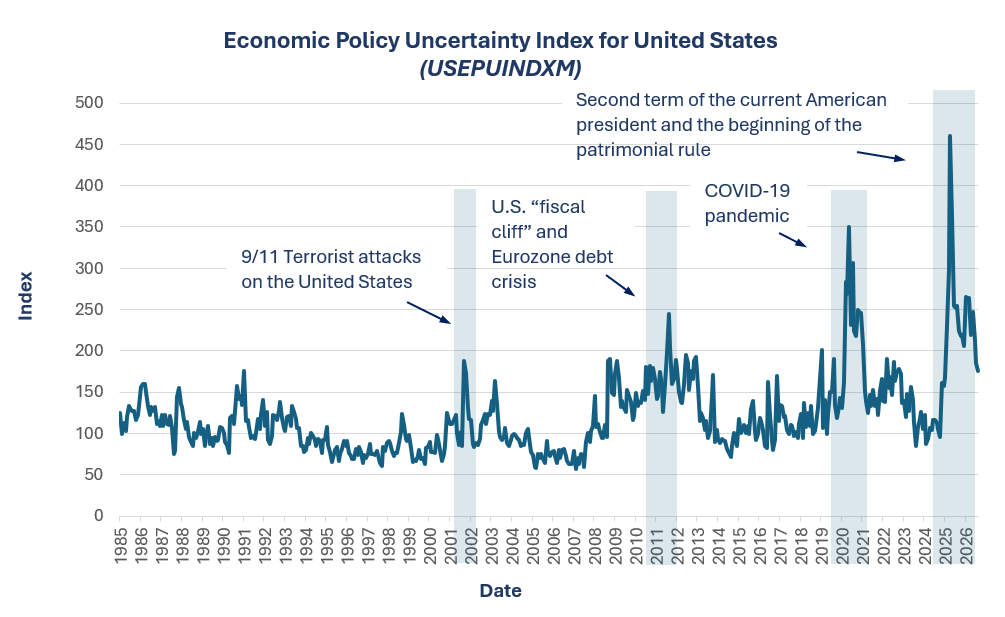
Source: Economic Policy Uncertainty Index for United States (USEPUINDXM), January-August 2026.
The trustee Becomes the heir
The American presidency was built as a kind of public trust or demanio pubblico. It is an office held for the public and administered by rules the trustee, or president, cannot change. However, a trustee who begins treating the estate as his inheritance has not stolen anything in his own eyes. He has simply corrected a misunderstanding about whose property it always was.
There are three areas in particular where the American president has digressed to the earlier, historical patrimonial form and they are important to point out in order to understand Americas behavior not as a sequence of erratic behaviors but as part of a change in the logic of the American presidency.
- Those who were formerly bureaucrats are now retainers
The first mark of patrimonial rule is the bond between the ruler and servant. A bureaucrat owes duty to the office which outlasts and constrains them whereas a retainer owes their duty to the master. Every regime is, at bottom, a personnel system, and the American president’s personnel practices have followed a household model from the start. Qualification for a senior position in government has rested on demonstrations of loyalty rather than competence in a defined sphere. Reclassifying career civil servants as removable at the discretion of the president is an attempt to convert a tenured bureaucracy into a staff of personal retainers. In the 1830s, Andrew Jackson filled the government with his own supporters on the principle that offices belong to the victor, and it took a reform law fifty years later in 1883 to create a civil service recruited by examination and protected from political dismissal. The civil service law was America’s attempt to take the household out of the state. The current American president is simply running that film backward, and claiming the reversal as popular democracy. Such a claim deserves to be taken seriously rather than dismissed, because a large part of the American public is vested in this belief.
- The treasury becomes the personal purse
The second mark of a patrimonial system is the fusion of the private and public economy. The current president is unconstrained by a constitutional order containing emoluments clauses and a norm separating public office from the president’s private enterprise. Foreign delegations at his private properties, family ventures expanding in jurisdictions under negotiation, the presidency intersecting openly with the family’s digital-asset and real-estate interests are now the new norms. The patrimonial ruler does not recognize the line between what belongs to the office and what belongs to the man. When the realm is the household, taking from it is not theft but instead it is housekeeping.
- Law and justice is administered as discretion
The third mark of a patrimonial regime is the treatment of law. Weber contrasted calculable, rule-bound justice with Kadijustiz, or decisions made based on the ruler’s sense of the case. The pardon power as it has been wielded by the current American president is a vivid illustration of how the ruler’s sense of the case has replaced a rational, rule-bound justice system. We have seen clemency extended to allies and to those whose prosecutions were treated as attacks on the president himself. The Department of Justice, as an institution, has been transformed from an institution administrating an impersonal order and application of laws to the president’s own personal legal apparatus. The “unitary executive theory,” championed by Ronald Reagan’s constitutional lawyers in the 1980s, has supplied a vocabulary for a patrimonial claim such that every exercise of executive power is the president’s power alone and shared by no other office or body.
Five costs of the household state
Weber cared about patrimonialism because of what he feared it did to the societies that lived under it. The costs he identified a century ago are the ones now worth watching for in the American case.
- Calculability declines
Rational capitalism depends on predictable law. When contracts and enforcement depend on favor, firms invest in access rather than productivity, and returns follow proximity to power instead of performance.
- The state loses competence
Career bureaucracies accumulate knowledge that survives across administrations. Subordinating expertise to loyal retainers makes the state worse at crises, taxation, and negotiation with professionally staffed foreign powers.
- Law becomes a weapon
If prosecution and pardon are instruments of favor, legal protection depends on one’s relationship to the ruler. Successors inherit the same tools and face pressure to use them.
- The line separating the public and private erode
Once officials, foreign governments, and businesses learn the president’s interests and the nation’s are treated as one, they deal with the household rather than the state.
- Succession becomes the central problem
Patrimonial systems depend on the person. Every election now inherits a household rather than an office, and a successor may find the household powers too useful to relinquish.
A fragile tilt of the market
Leading up to the 2024 U.S. presidential election, the impersonal state had lost legitimacy for a majority of the country. The federal governmental bureaucracy came to be seen as an unelected rival household estate. Against that perception, the victorious American presidential candidate presented himself as the people’s direct agent who was singularly capable of dismantling the hostile household. However, the mandate to dismantle was also a mandate to disrupt.
American capitalism is Schumpeterian in that it creates by destroying, but the creative mode works only when competitors do the destroying under rules that outlast them. Weber’s warning was that when destruction flows from the ruler’s discretion rather than lasting rules then what is created is not stronger enterprise but a market tilted toward the patriarch.
The near danger is not the man but the model. When the current American president leaves office the model remains. A market tilted toward patrimonialism is fragile because it rests on one individual passing it to another. The looming question is whether the successor to the current American president dismantles the household or moves into it.
The information and opinions contained herein do not constitute an invitation to take out a contract for the provision of investment services, nor a personalised recommendation; they are not contractual in nature, they are not drafted pursuant to a legislative provision, and they are not sufficient to make an investment decision. The information and data are deemed to be correct, complete and accurate. However, Banor does not issue any representation or guarantee, express or implied, on the accuracy, completeness or correctness of the data and information and, where these have been prepared by or derive from third parties, does not assume any liability for the accuracy, completeness or adequacy of such data and information, even if its sources are deemed to be reliable.
Unless indicated otherwise, the data, information and opinions are understood to be up-to-date at the date of preparation, and may change without notice or subsequent communication. Any citations, summaries or reproductions of the information, data and opinions provided herein by Banor should not alter their original meaning, nor may they be used for commercial purposes, and they must cite the source (Banor SIM S.p.A.) and the website www.banor.it. Citation, reproduction and use in any case of data and information from third-party sources must, if permitted, fully comply with the rights of the related data controllers.
Banor SIM S.p.A., via Dante 15 – 20123 Milan, registered in the Business Register of Milan 06130120154 – R.E.A. (Economic and Administrative Index) of Milan 1073114. Consob authorisation, resolution no. 11761 of 22/12/1998. Registered in the Register of Brokerage Companies (SIM) under no. 31 and member of the Italian National Guarantee Fund (Fondo Nazionale di Garanzia).