
A cura di Keenan Yoho, Senior Advisor di Banor
Victory Without Government
The American midterms changed the balance of seats in Congress. They did not change the conditions under which the United States must exercise power.
An election changes a government but it does not change geography. Two weeks after the vote it is clear that the Democratic Party will control the House of Representatives as well as the U.S. Senate. There may be a presumption that the American president has been checked, the legislature will investigate, and the system will govern again. But winning an election is one thing and governing is another. The White House, Congress, and the boards of strategically important corporations exhibit similar conditions. Authority has concentrated in personalities, and the institutions charged with restraining those personalities have lost the habit of independent judgment. This is a structural problem, not a partisan one, and it is visible to Moscow, Beijing, Tehran, and every allied capital that must plan beyond the next American election. America’s quarrel with itself favors those who wish it ill and forces those who depend on it to hedge. As the dust of the midterm elections settles, the recriminations surrounding Nvidia crest, and two important observations must be made:
-
- first, a patrimonial sensibility is the prevailing model in the American White House and its technology industry driving its economy;
- second, the new majority in Congress cannot fundamentally change the American geopolitical position abroad without decisive, bold, and risky moves that it is unlikely to take because the agenda of Congress is steered from the White House, where each new order, tariff, or military strike will determine what the legislature will spend its week debating.
The patrimonial impulse abides
The American Constitution was designed against the patrimonial tendency described in this newsletter in September, whereby a ruler administers their office as though it were an extension of their household and personal property. The American president’s second term has bent toward the patrimonial impulse. It has run on tariffs issued by decree and a war with Iran that began with audacity but lingers without political victory to match. All the while, a Republican Congress deferred to the president rather than exercise its own authority.
A corporate board operates under a different body of law but confronts a related test, which is whether directors can govern a company when the chief executive believes that exceptional success entitles them to exceptional deference.
The recent case of Nvidia lays bare a broader problem with the American technology industry. On November 12, the board removed Jensen Huang as chief executive and director after thirty-three years leading the company he co-founded. The removal was called a resignation but was a firing. Huang’s offense was cavorting with a woman U.S. intelligence agencies say is a Chinese Communist spy, a former executive of Megaspeed, a Singapore-based customer of Nvidia that was spun out of a Chinese state-owned cloud company.American authorities began investigating Megaspeed in 2024 over the diversion of advanced Nvidia chips to China that their military would use to train models that find targets, guide autonomous weapons, and simulate the warheads it cannot test. Sales of these chips to China were specifically forbidden through export controls put in place in 2022. Nvidia placed Megaspeed on a no-sell list in June 2025 but such a list is a company policy and not a law, and in a patrimonial firm the person who can make, bend, or ignore company policy is the chief executive.
Megaspeed’s Malaysian subsidiary took delivery of more than 200 shipments of restricted Nvidia technology worth nearly $2 billion before the no-sell listing and more than $800 million more in the eight months after it. The Nvidia board failed in its oversight responsibility. Only on November 12, 2026 did Nvidia name Harvey Jones as the first board chair in the company’s history. Five days later the directors created a National Security and Export Control Oversight Committee.This evolving episode exposes the dangers executives pose who regard their institutions as household property particularly when that property is strategic, dual-use, military grade technology. A market that leaned for three years on one company now leans on an interim chief, an open investigation, and a hearing schedule.
Beyond the reach of Congress
The new Congress was elected on a wave of American anger at food and fuel prices driven up by a war the president had promised not to start and by his tariffs no one voted on. However, a new Congress does not fundamentally change the geopolitical position of United States. The new Congress brings the power to legislate, to investigate, and to withhold money but it does not have the authority to conduct foreign policy, which the U.S. Constitution places with the president who commands the armed forces, appoints envoys, and can veto any bill unless two-thirds of each chamber overrides him (the last time the U.S. Congress formally declared war was June 5, 1942). With the advent of the nuclear weapon, the president does not ask Congress for permission to make war. The current American president chose to attack Iran and has declared the war won or over several times since March 2026. Yet a blockade remains in force, tankers are striking mines in the Strait of Hormuz, and Tehran has raised its price for a settlement which is translating into gas prices at the American pump. Congress can withhold money, but it cannot reopen a strait or negotiate a settlement because it does not have the Constitutional power to do so..
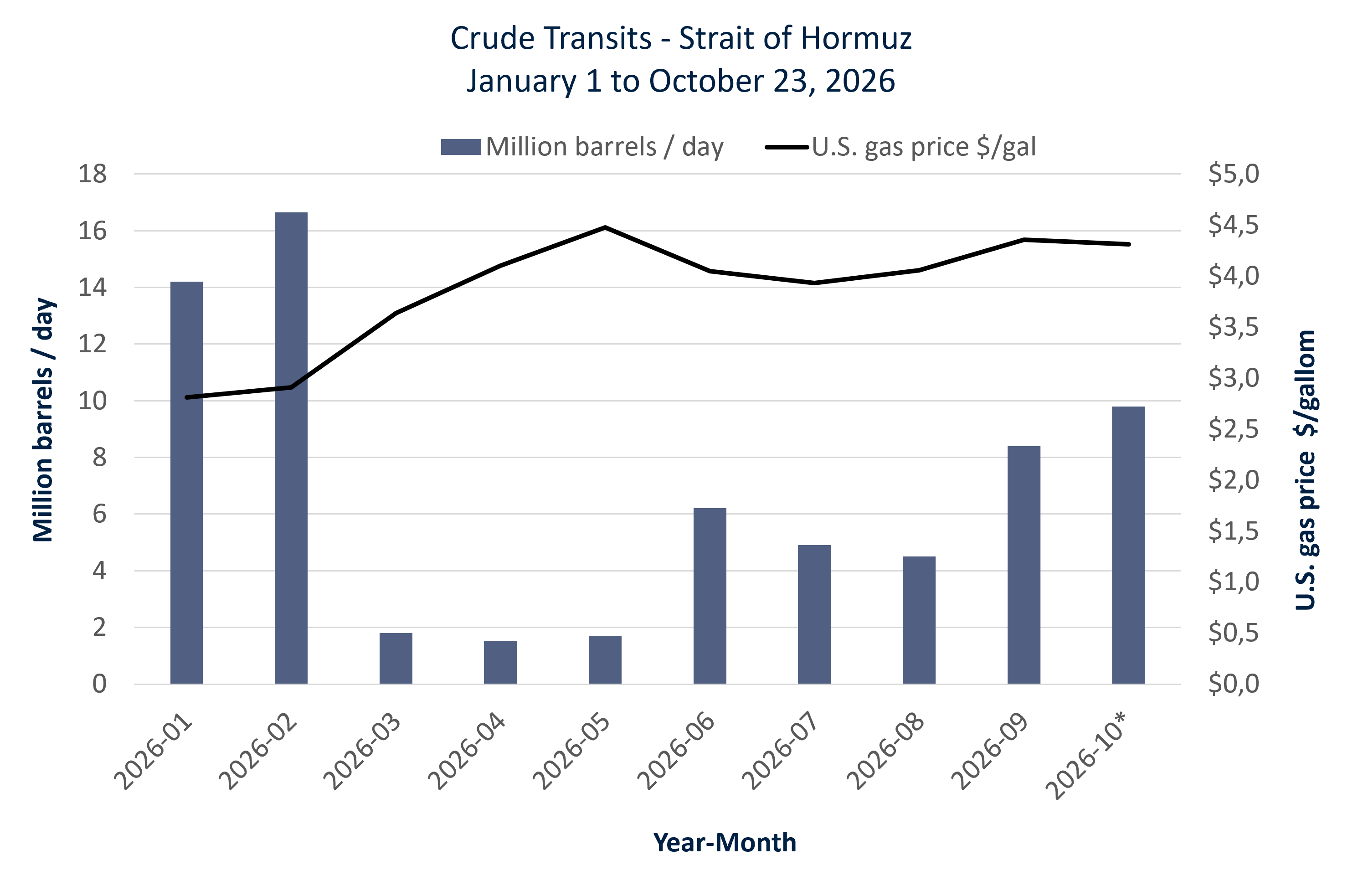 Sources: Monthly crude-oil flows through the Strait of Hormuz were estimated by combining non-Iranian shipment data with available Iranian crude-flow estimates from Kpler and the International Energy Agency (IEA), cross-checked against U.S. Energy Information Administration (EIA) quarterly totals.
*October data only reported October 1-23.The bill for neglect
Taiwan lies eighty miles off the Communist Chinese coast and several thousand from California and the foundries that make Nvidia’s chips sit there too. In Abu Dhabi, the first Russia-Ukraine talks in nine months have produced an agreement on the largest prisoner exchange of the war but with no movement on territory. The American mediators were the president’s personally selected envoy and his son-in-law who answer to him and not to Congress. Allies should therefore take the midterm result seriously without mistaking it for a strategic reset. The new Congress may constrain the president, but vetoes and investigations without compromise produce stalemate and the burdens of geography will persist. Meanwhile, the American people have an increasing sense that no one is at the internal controls of a country recently befallen by massive technology failures in their airlines, air traffic control system, banking systems, intelligence systems, and everyday desktop applications. American institutions have become very good at conflict but poorer at administration. They can mobilize, strike, litigate, and campaign. However, these institutions struggle to administer and maintain in technology-driven culture built for motion but with little patience for maintenance. The appetite for the fight governs the White House as well as the boardroom and both will find that the bill for neglect arrives long after the hangover of victory.
The information and opinions contained herein do not constitute an invitation to take out a contract for the provision of investment services, nor a personalised recommendation; they are not contractual in nature, they are not drafted pursuant to a legislative provision, and they are not sufficient to make an investment decision. The information and data are deemed to be correct, complete and accurate. However, Banor does not issue any representation or guarantee, express or implied, on the accuracy, completeness or correctness of the data and information and, where these have been prepared by or derive from third parties, does not assume any liability for the accuracy, completeness or adequacy of such data and information, even if its sources are deemed to be reliable.
Unless indicated otherwise, the data, information and opinions are understood to be up-to-date at the date of preparation, and may change without notice or subsequent communication. Any citations, summaries or reproductions of the information, data and opinions provided herein by Banor should not alter their original meaning, nor may they be used for commercial purposes, and they must cite the source (Banor SIM S.p.A.) and the website www.banor.it. Citation, reproduction and use in any case of data and information from third-party sources must, if permitted, fully comply with the rights of the related data controllers.Banor SIM S.p.A., via Dante 15 – 20123 Milan, registered in the Business Register of Milan 06130120154 – R.E.A. (Economic and Administrative Index) of Milan 1073114. Consob authorisation, resolution no. 11761 of 22/12/1998. Registered in the Register of Brokerage Companies (SIM) under no. 31 and member of the Italian National Guarantee Fund (Fondo Nazionale di Garanzia).