



Commentary by Keenan Yoho, Banor Senior Advisor
It Is No Longer 1979. Strategic reversals and new geopolitical axes.
On February 28, 2026, American and Israeli forces killed Iran’s Supreme Leader Ayatollah Ali Khamenei. With him died the last figure of the Iranian Islamic revolutionary generation that seized power in 1979. Why it happened is not so much the question as why it took this long.
The answer begins in 1979. In November, Iranian students stormed the American embassy in Tehran and held fifty-two diplomats for 444 days. U.S. President Carter tried to respond with Operation Eagle Claw, a helicopter rescue mission that ended in catastrophe in the Iranian desert with eight Americans dead and the wreckage left burning on the sand. Iran had delivered its first lesson to the United States: it could strike, absorb the response, and wait Washington out.
Over the course of four decades, two constraints made American retaliation against Iran more expensive than absorption. The first was the Cold War, which had unwritten rules: mutual restraint, proxy conflicts only, and no direct invasions of sovereign states outside recognized spheres of influence. The paramount rule was never to take an action that would leave a nuclear adversary no choice but to respond. Those rules were already under strain when the Soviet Union invaded Afghanistan in December 1979 placing Soviet armor on Iran’s eastern border. The invasion fell within Moscow’s recognized sphere of influence and did not shatter the Cold War rules but instead demonstrated how binding they were. The U.S. was now simultaneously managing a hostage crisis in Tehran and watching Soviet opportunism manifest in its forces moving toward a position to threaten Gulf oil routes without being able to act freely in the region.
The second constraint was the oil weapon. Through the Strait of Hormuz moves one-fifth of global oil supply. Striking Iran in 1979, or almost any time after, risked closure, a price shock, and damage to allied economies that depended on Gulf oil far more than the United States did. Together the two constraints created a structural shield for Iran and a policy cage for the United States. The Islamic Revolutionary Guard Corps (IRGC) understood this perfectly and built its proxy network to include Hezbollah, Hamas, the Houthis, Shia militias across Iraq and Syria around the new reading of American limits. Beirut only confirmed the pattern of American limits. On October 23, 1983, a Hezbollah bomber, acting on Iran’s direct orders, destroyed the U.S. Marine barracks, killing 241 Americans, the deadliest single day for the Marine Corps since Iwo Jima in World War II. President Reagan recognized the Iranian fingerprints on the operation and withdrew from Lebanon without retaliating. The IRGC drew the conclusion that governed its strategy for the next four decades: proxy war works and the combination of the Cold War cage and the oil weapon created a structural shield for Iran.
What made Iran categorically more dangerous than any Cold War adversary was not its geography. It was its radical Islamic ideology. The Cold War rules held because both sides shared one assumption: they wanted to survive. Every adversary the United States has faced since 1945 has been deterrable on the terms that they wanted to survive: the USSR at Cuba, China in Korea, Russia in Ukraine. Not one Soviet operative ever chose death as a mission parameter against American civilians. Radical Islamic ideology removes that assumption. It is maximalist, nihilistic, and suicidal in ways that no other American adversary has ever been in practice. For Americans, September 11 is the hard evidence. Nineteen men willingly died to kill three thousand of its citizens. This was not a tactic but instead a theology. While Iran did not fly the planes it did build the ideological and operational architecture that made the method of using suicide bombing justified by a martyrdom doctrine through proxy networks. The Cold War framework had no answer for an adversary that had removed survival from the equation. Indeed, the prevailing doctrine of the Cold War was that of mutually assured destruction (MAD) which rested upon the assumption that both sides desired to survive.
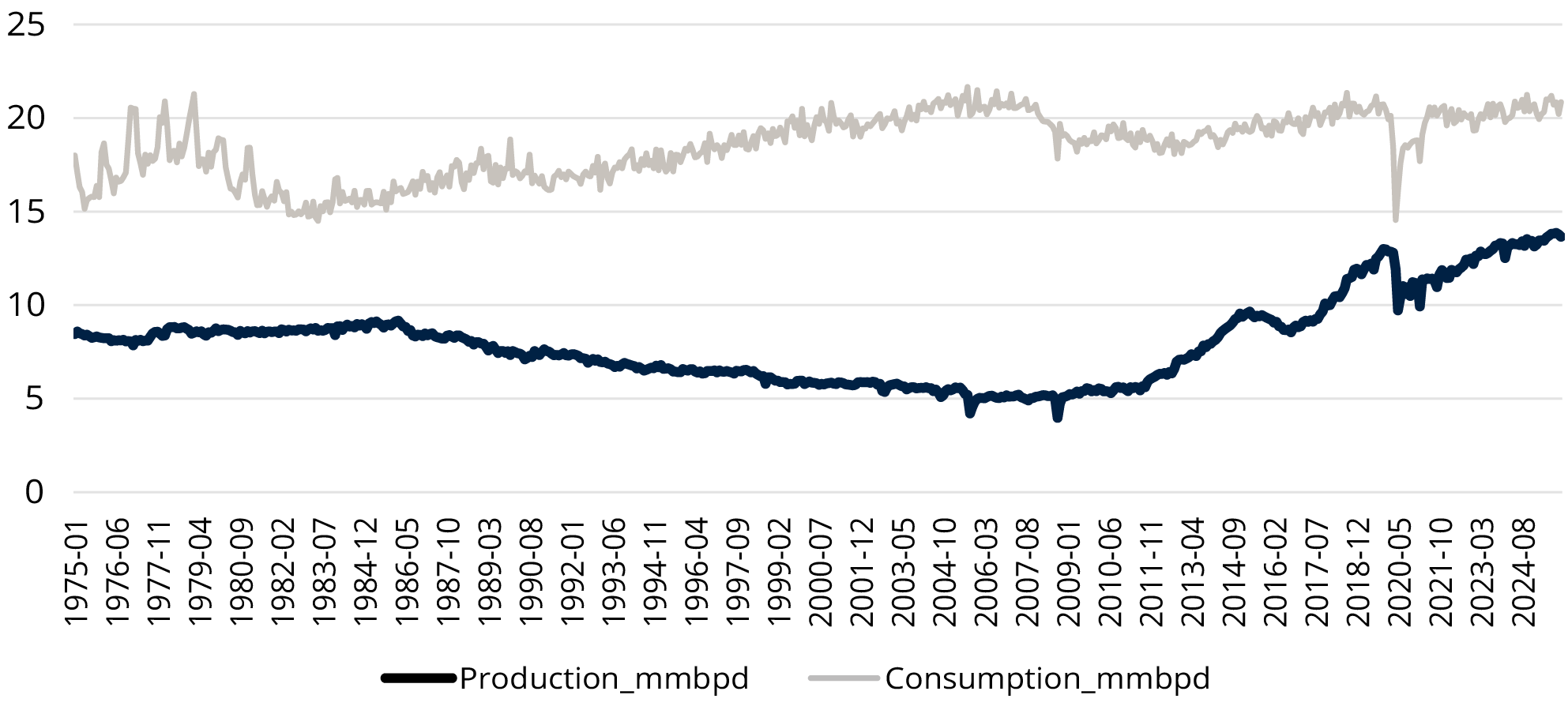
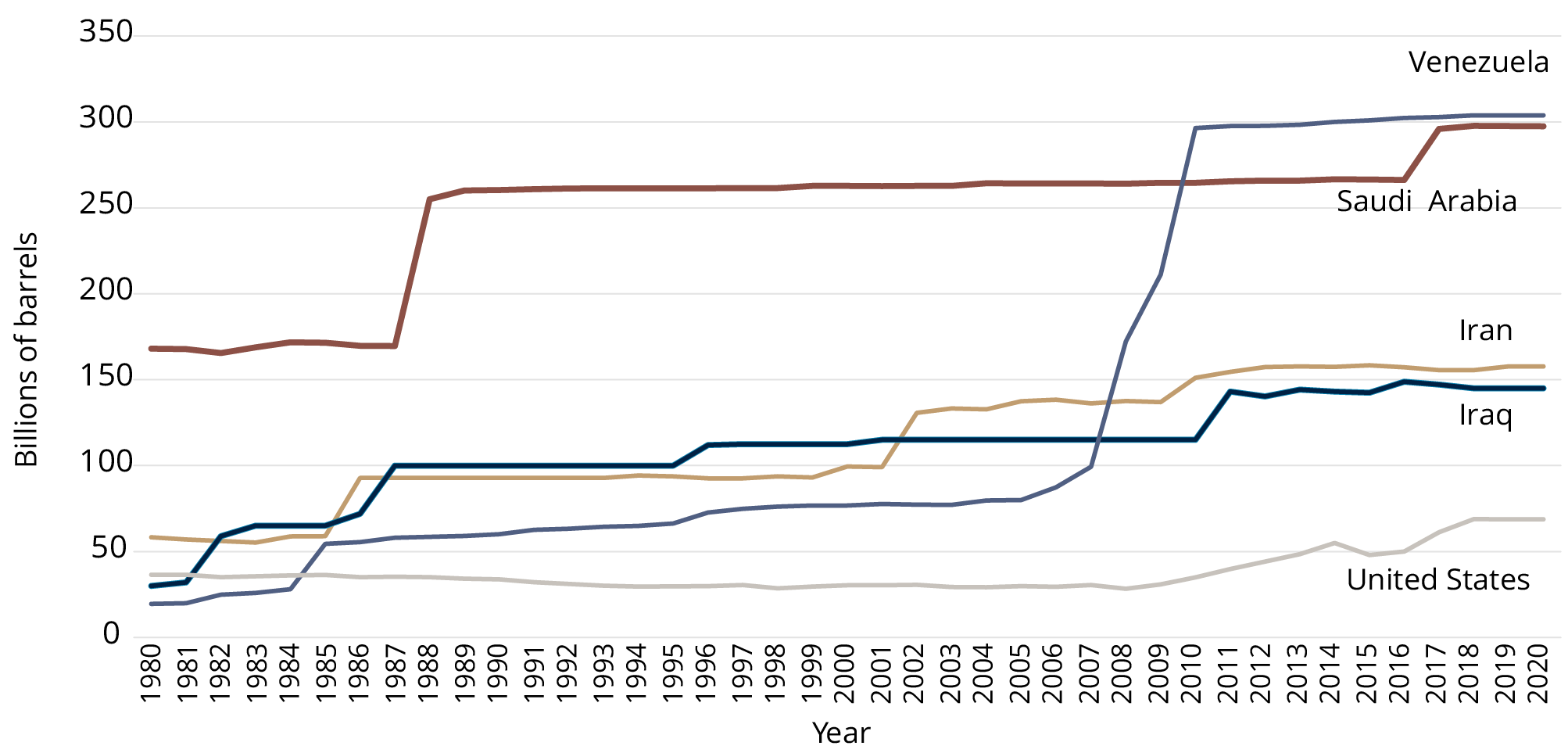
Iran’s protection was always a combination of geopolitical rules, economic leverage, and American military limitations. By February 2026, all three had expired in sequence. The Cold War ended in 1991. The American shale revolution made the United States the world’s largest oil producer, severing the link between Gulf stability and American economic security. The American control of Venezuelan energy resources extends this buffer further by placing the world’s largest oil reserves in U.S. control. The rules-based order collapsed under the weight of its own unenforced ultimatums. In 2012, U.S. president Obama drew a red line in Syria over the use of chemical weapons and then refused to enforce it in 2013 when Assad used sarin. President Putin of Russia was watching and a year later, in 2014, invaded Ukraine, acknowledging that the U.S. now considered its commitments were optional. The foundational norm of the post-war order broke and did not recover.
United States Oil Production and Consumption (January 1975 – January 2026) – Millions of Barrels Per Day (mmbpd)
Source: U.S. Energy Information Agency (EIA)
Proven Oil Reserves – Billions of Barrels
Source: Energy Institute Statistical Review of World Energy (1980–2020)
What has changed for the United States has not just been its removal of the oil weapon but also its military capability and in this domain the transformation has been total. The distance between Eagle Claw in 1979 and Operation Epic Fury in 2026 is not merely forty-six years. It is the distance between a country that could not rescue its own diplomats on a Thursday and one that could kill a supreme leader on a Saturday. The man-hunting apparatus that found and killed Osama bin Laden, killed the leader of ISIS, al-Baghdadi, and eliminated the commander of the elite Iranian Quds Force, Qassem Soleimani at the Baghdad airport in 2020 is the culmination of decades of weapons development, intelligence, surveillance, and reconnaissance technology, and an industrial decision process. Soleimani was the proof of concept and demonstrated that any psychological barrier against targeting Iranian leaders by the United States had been broken six years before February 28, 2026.
Iran’s revolutionary regional empire, built over four decades using bloody proxy warfare, a missile capability, and a nuclear program, rested on the assumption that American constraints were permanent features of the strategic landscape. However, these constraints were the product of a specific historical moment: the Cold War, American oil vulnerability, the limits of precision military technology, and a rules-based order whose guarantor was still willing to be bound by its own procedures. Each of those conditions have expired. The Iranian regime bet its survival on an assumption of American weakness and a permanence of constraint and it lost.
The information and opinions contained herein do not constitute an invitation to take out a contract for the provision of investment services, nor a personalised recommendation; they are not contractual in nature, they are not drafted pursuant to a legislative provision, and they are not sufficient to make an investment decision. The information and data are deemed to be correct, complete and accurate. However, Banor does not issue any representation or guarantee, express or implied, on the accuracy, completeness or correctness of the data and information and, where these have been prepared by or derive from third parties, does not assume any liability for the accuracy, completeness or adequacy of such data and information, even if its sources are deemed to be reliable.
Unless indicated otherwise, the data, information and opinions are understood to be up-to-date at the date of preparation, and may change without notice or subsequent communication. Any citations, summaries or reproductions of the information, data and opinions provided herein by Banor should not alter their original meaning, nor may they be used for commercial purposes, and they must cite the source (Banor SIM S.p.A.) and the website www.banor.it. Citation, reproduction and use in any case of data and information from third-party sources must, if permitted, fully comply with the rights of the related data controllers.
Banor SIM S.p.A., via Dante 15 – 20123 Milan, registered in the Business Register of Milan 06130120154 – R.E.A. (Economic and Administrative Index) of Milan 1073114. Consob authorisation, resolution no. 11761 of 22/12/1998. Registered in the Register of Brokerage Companies (SIM) under no. 31 and member of the Italian National Guarantee Fund (Fondo Nazionale di Garanzia).